AN ACADEMIC RESEARCH CENTER OF THE UNIVERSITY OF THE PHILIPPINES-DILIMAN IN THE COLLEGE OF SOCIAL SCIENCES AND PHILOSOPHY THAT IS COMMITTED TO ANALYZE AND DEVELOP ALTERNATIVE PERSPECTIVES ON PHILIPPINE, REGIONAL, AND GLOBAL ISSUES
Developments in the Law of Territorial Acquisition, Law of the Sea and Energy Law:
Their Relevance to the SCS Dispute
(A Public Lecture by Melissa Loja, University of Hong Kong)
2 September 2014 (Tuesday) 2pm – 4pm
Third World Studies Center, Lower Ground Floor, Palma Hall,
University of the Philippines, Diliman, Quezon City
Program
2:00 – 2:05
Opening Remarks
2:05 – 2:10
Introduction of the Speaker
2:10 – 3:10
Lecture
Melissa Loja, PhD Candidate (Public International Law), University of Hong Kong
3:10 – 3:30
Reaction
3:30 – 4:00
Open Forum
About the lecturer
Melissa Loja is a PhD candidate in the Faculty of Law of the University of Hong Kong. Her field of research is public international law and her areas of interest are energy law, law of the sea and law of territorial acquisition.
The Third World Studies Center is pleased to announce its new deputy director, Prof. Jely A. Galang. Prof. Galang is an assistant professor of the Department of History, College of Social Sciences and Philosophy, University of the Philippines-Diliman. He has a master's degree in history from UP Diliman, and is currently pursuing doctoral studies in history in the same university. Prof. Galang's particular fields of interest include the Chinese in the Philippines and local and social history in 19th century Philippines and has done work on Ilocano migration. He is currently writing his PhD dissertation on Chinese migration in the Philippines from the 19th to the early years of the 20th century.
Please address official communications to Prof. Galang via the Center. Official e-mails may be sent to uptwsc@gmail.com.
The 2014 UP TWSC Public Lecture Series on Natural Disasters
Lecture 1
Communicating Risks, Risking Miscommunication:
Mass Media and the Science of Natural Disasters
Wednesday 3 September 2014, 9:30 – 11:30 am
Pulungang Claro M. Recto, Bulwagang Rizal (Faculty Center),
University of the Philippines, Diliman, Quezon City
Please click here for the audiovisual recording of the lecture.
PROGRAM
9:30 – 9:35 Opening Remarks
9: 35 – 9:40 Introduction of the Lecturer and Reactors
9:40 – 10:20 Lecturer
Garry Jay Montemayor
Chair, Department of Science Communication
College of Development Communication
University of the Philippines Los Baños
10:20 – 11:05 Reactors
Nathaniel "Mang Tani" Cruz
GMA Resident Meteorologist and Former PAGASA Director
Shaira Panela
Freelance Science Journalist
Maria Luisa Bolinao
Professor, Department of History
College of Social Sciences and Philosophy
University of the Philippines Diliman
11:05 – 11:30 Open Forum
Moderator
Jely Galang
Deputy Director, Third World Studies Center and
Assistant Professor, Department of History
College of Social Sciences and Philosophy
University of the Philippines Diliman
ABOUT THE LECTURE
When Typhoon Yolanda struck central Philippines, the public was steered in all directions in a tangle of terminologies. In the aftermath, government agencies had great difficulties defending their accurate forecasts over the lack of a clear explanation the public can understand. As a sign of admission, the PhilippineAtmospheric,GeophysicalandAstronomicalServicesAdministration(PAGASA),the country’s weather agency, was quoted saying “more could have been done in explaining to the public the magnitude and gravity of a storm surge.” Malacañang was also quoted saying “perhaps [the government] could've communicated the danger better….“[we could've said] tsunami-like effect.” Be they warnings of a “storm surge” or a “tsunami,” the institutions the public turns to during natural disasters, it seemed, failed to reach out to an already wary and confused public. Accusations were hurled: If the people in Samar and Leyte have been warned against a tsunami, more lives would probably have been saved. The issue on semantics is not negligible, especially in times of natural disasters—when words in fact do save lives, as averred by one advocacy group on disaster risk management in the country. The surge in scale and occurrence of unprecedented risk from natural disasters points to the increasing importance of science communication, an emergent domain in the study and practice of development communication in the country. Science communication in the Philippines,accordingtoformerDeanofUniversityofthePhilippinesLosBañosCollegeof DevelopmentCommunicationDr.MariaCelesteH.Cadiz,proceedsfromthecommunicationof scientific and technical information to a “cognizant…cultural process.” In describing the phenomena of natural disasters, science communication or the process of making science concepts popular and more comprehensible to various people through different media is gradually gaining currency and this is where the mass media comes to the fore as purveyor of eye-witness accounts. This is indicative of the Department of Science and Technology’s vision for science journalism in the country: “to popularize science through mass media and identify ways to bridge the communication gap between the scientists and the public.” The Center for Community Journalism and Development in the Philippines, however, reveals a still inchoate field of science communication in the country, particularly among the mass media: “low awareness and understanding of disaster risk and climate change concepts, plans, policies, programs and in some cases, even basic learning points such as definition of terms“are some of the factors that prevent the media from practicing an effective science communication of natural disasters. A quick Google search on the key words typhoon Yolanda would generate reports that mostly focus on casualties, destruction of properties, and foreign aid or donations. There are minimal reports on the science of the disaster and on why and how such disasters occur. How can we intimate an effective science communication of natural disasters in the country? What is the role of the mass media in the intrinsic relationship of science communication and natural disasters? How does the Philippine mass media situate itself as an active player in science communication as the country continues to be beset by natural disasters?
KEY QUESTIONS:
What is science communication? What is the role of the mass media in the intrinsic relationship of science communication and natural disasters?
How does the mass media situate itself as an active player in science communication and in reporting climate risks in particular? What is the current state of science journalism in the Philippines? Is there reluctance that science reporting will not sell to the public?
How can we describe the relations and dynamics of science communication among scientists, journalists, and the public in the Philippines?
How should “effective science communication” be conceptualized? Is it about increased public awareness of the issue? Or should it also aim for public engagement in disaster risk reduction and management? What ethical aspects should be considered by a science journalist?
Is there such a thing as Filipino science communication or do we just adopt "international standards"? How do we factor in cultural context/specificities? What is the future of climate risk reporting in the Philippines?
See link for the concept paper of the public lecture series. See link to view the lecturer's full presentation.
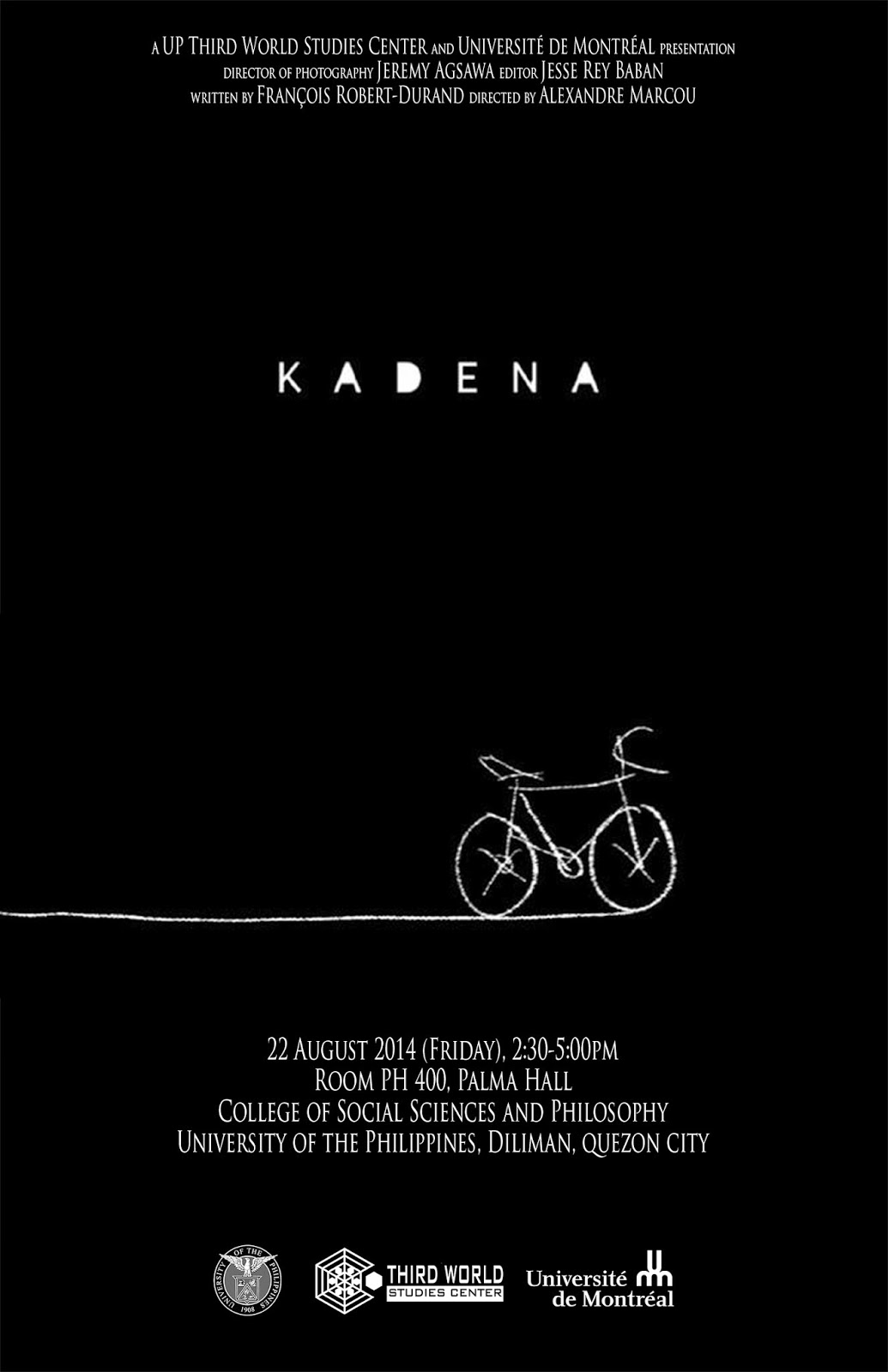
For years, Roger has depended on his bicycle to go to his place of work in Metro Manila, and from there to safely pedal his way back home to his family in the outskirts of the city. "Kadena" chronicles how Roger moves along and lives through the monstrous sprawl that is Metro Manila--from the grunts of its monumental traffic jams to the glitzy hiss of its malls and skyscrapers. This is Roger on how the city has changed before his eyes, on how the desperate have tried to turn it into a place of refuge and the poor aspired for resilience amid its unending squalor. "Kadena" is about two lives on the road chained to each other: that of the city and Roger's.
“Kadena” will be screened
for free and open to the public on 22 August 2014 (Friday) from 2:30 to
5:00 PM at Room PH 400, Palma Hall, College of Social Sciences and
Philosophy, University of the Philippines-Diliman.
A brief forum with the documentary’s production team will also be held after the screening.
"Kadena" is a production of the University of the Philippines Third
World Studies Center (TWSC), in partnership with the Department of
Political Science of the Université de Montréal (UdM) under the Student
for Development project. Since 2011, undergraduate students from the UdM
and interns from TWSC have collaborated to make short documentaries on
a particular theme. "Kadena" is a creative exploration of the theme
urban transformation with Jeremy Agsawa as director of photography, Jesse Rey Baban as editor, François RD (Robert-Durand) as writer, and Alexandre Marcou as director.
Money Politics: Patronage, Clientelism, and Electoral Dynamics in Southeast Asia
A Free Public Lecture by Paul D. Hutchcroft
Friday, 05 September 2014
2:30 p.m. to 5:00 p.m.
Seminar Rooms 206-207
GT-Toyota Asian Cultural Center
University of the Philippines Diliman, Quezon City
About the lecture The term ‘money politics’ is widely used throughout Southeast Asia, commonly as a vague but derisive label for political practices deemed unsavoury and in need of reform. But what is it, exactly, and how does it vary from one setting to another? Why is it important and what are its impacts? Throughout the region, large sums of patronage—particularistic benefits, including cash, goods, appointments, or other rewards—are distributed via clientelist and other political networks. Sometimes illegal or illicit, other times above-ground and tacitly condoned, such practices span the electoral cycle and deeply affect the quality and character of governance, democratic structures, and national integration.
In this talk, Paul Hutchcroft will provide an overview of a major collaborative research project on money politics in Southeast Asia that traces the character, causes and implications of patronage in Indonesia, the Philippines, Malaysia, and Thailand. Particular attention will be paid to the May 13, 2013 midterm elections in the Philippines. About the lecturer Paul D. Hutchcroft is a scholar of Comparative and Southeast Asian Politics, who has written extensively on Philippine politics and political economy. At present, he serves as Lead Governance Specialist with the Australian Embassy in Manila. He is on leave from his position as Professor of Political and Social Change at the Australian National University (ANU). From 2009 to 2013, he served as founding director of the School of International, Political and Strategic Studies in the Australia National University's (ANU) College of Asia and the Pacific. He is the author of Booty Capitalism: The Politics of Banking in the Philippines (1998).
Kasarinlan, the Philippine Journal of the Third World Studies Center, is a CHED-accredited biannual publication that brings together local and international refereed articles on issues affecting the Philippines and the Third World. One section of Kasarinlan is devoted to reviews of materials on relevant contemporary issues and perspectives.
We accept unsolicited reviews of recently released books, films, websites, and other information sources. We can also provide you with copies of the latest publications relevant to the Third World from some local and international publishing houses in exchange for a review. Reviews should be between 1000 and 1500 words. Please send all submissions and queries to kasarinlan@gmail.com.