
This book presents the findings conducted by the University of the Philippines Third World Studies Center (TWSC) from 2007 to 2008. The project explores the various dimensions of human security as perceived and experienced by individuals in the community, major stakeholders and dutybearers, as well as the marginalized groups in selected conflict areas in the Philippines. It aims to develop a human security index that would serve as a planning and evaluation tool to guide policy making of key government agencies, civil society organizations, and non-governmental organizations. The proposed index is envisioned to describe the scope and magnitude of human security in the Philippine context as it incorporates dimensions, which need to be taken into account in the process of conflict prevention and peace building.
The book will be launched together with the anniversary of the Office of the Presidential Adviser on the Peace Process (OPAPP) on September 15, 2010. A PDF version of the book can now be viewed and downloaded free by clicking on this link.
Friday, September 03, 2010
Soft Launch of "Developing a Human Security Index for the Philippines"

Tuesday, August 10, 2010
Kasarinlan is now CHED-accredited
Commission on Higher Education (CHED) Memorandum Order 9, s. 2010 accredits Kasarinlan as a Category A-2 (very good to excellent) research journal for 2009-2012. As per CHED Memorandum 13, 2009, the accreditation means that for faculty members of "state universities and colleges evaluated under NBC No. 461, publication in the journal is credited as an international level publication." Kasarinlan's full digital content is accessible without charge at http://journals.upd.edu.ph/index.php/kasarinlan/index
Thursday, July 08, 2010
Invitation to Individual Rights and the Free Market: A Round Table Discussion with Dr. Tom G. Palmer


The Third World Studies Center (TWSC), in cooperation with the UP Department of Political Science, would like to invite faculty and graduate students to "Individual Rights and the Free Market," a round table discussion (RTD) with Dr. Tom G. Palmer. The RTD will be on July 15, 2010 (Thursday) 4:00 p.m. – 6:00 p.m. at the TWSC, Lower Ground Floor, Palma Hall, College of Social Sciences and Philosophy, University of the Philippines, Diliman, Quezon City.
PROGRAM
3:45 – 4:00 REGISTRATION
4:00 – 4:05 OPENING REMARKS
Maria Lourdes G. Rebullida
Chairperson, Department of Political Science
College of Social Sciences and Philosophy
University of the Philippines-Diliman
4:05 – 4:10 MESSAGES
Bienvenido S. Oplas Jr.
President, Minimal Government Thinkers, Inc.
Jude D. Blanchette
Manager, Institute Relations for Asia
Atlas Economic Research Foundation
4:10 – 4:35 SPEAKER
Tom G. Palmer
Vice President, Atlas Economic Research Foundation
Senior Fellow and Former Vice President, Cato Institute
4:35 – 4:55 REACTORS
Temario C. Rivera
Professor, International Christian University of Tokyo
Alexander R. Magno
Professor, Department of Political Science
College of Social Sciences and Philosophy
University of the Philippines-Diliman
4:55 – 5:30 OPEN FORUM
5:30 – 6:00 MERIENDA CENA
MODERATOR
Amado M. Mendoza Jr.
Professor, Department of Political Science
College of Social Sciences and Philosophy
University of the Philippines-Diliman
ORGANIZERS
Third World Studies Center
UP Department of Political Science
About the Speaker
Dr. Tom G. Palmer is a libertarian intellectual and his passion is promoting individual liberty, free market and free trade, and individualism. He just came from speaking engagements in Central Asia—Kyrgyztan, Afghanistan, and Tajikistan. He is interested in engaging faculty and graduate students to talk on topics such as individual rights and liberty, rule of law, and free trade. For more information, please see his brief bio:http://tomgpalmer.com/about/.
For Dr. Palmer's presentation, please click this link to obtain a copy.
Wednesday, June 16, 2010
Did the Left Get it Right? (A Public Forum)
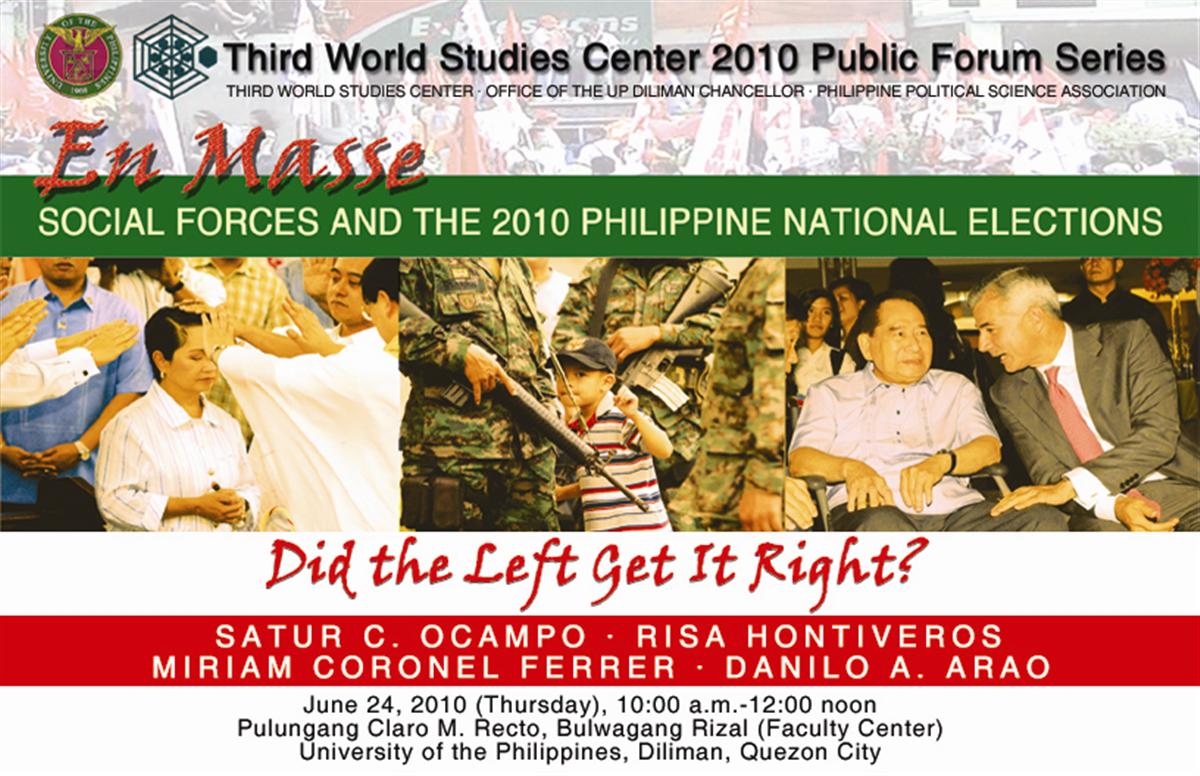
June 24, 2010, 10:00am-12:00nn
Pulungang Claro M. Recto, Bulwagang Rizal (Faculty Center), University of the Philippines-Diliman, Quezon City
Read the transcript here.
About the Forum
In the last decade, the Left crossed the line it swore it will never cross--most tellingly in the recent elections. It has entered the arena of power and contestation, which for a long time has been dominated by traditional politics. "Progressive" lawmakers Risa Hontiveros, Liza Maza, and Satur Ocampo, who are set to retire in the Lower House due to term limits, gambled to secure a seat in the other legislative branch. Hontiveros joined the much-hyped yellow camp while Maza and Ocampo allied with a self-proclaimed champion of the masses. Unfortunately, they got caught in a no-win situation. The partylists, such as Bayan Muna and Akbayan, on the other hand, will keep their clout in the political arena. Nine representatives from the Left were recently proclaimed members of the 15th Congress. What could explain the defeat of the Left while trying to expand its influence in the political arena? Did the Left spend enough time for cogitation before considering taking these actions? Why did their mass base, as shown in the unbroken successes in the Lower House, fail to bring them to the Senate?
Even with these developments, openly participating in the polity, its focal point of attack, remains an unusual direction for the Left. Cooptation and demise of long-held principles, though, are feared to be the prices of this detour. What led to these acts of irony? Are the political activists from the Left taking themselves in the right direction? Is this not a deviation from their envisioned track? Is a rethinking pressing at this time with the seemingly continuing failure of the Left to expand its mass of believers? What is at stake in this turn of events vis-à-vis the incoming administration?
PROGRAM
09:30-10:00
REGISTRATION
10:00-10:05
WELCOME REMARKS
Maria Ela L. Atienza
Director
Third World Studies Center
College of Social Sciences and Philosophy
University of the Philippines-Diliman
10:05-10:10
INTRODUCTION OF THE SPEAKERS AND REACTORS
SPEAKERS
10:10-10:30
Satur C. Ocampo
Representative
Bayan Muna Partylist
House of Representatives
14th Congress of the Philippines
10:30-10:50
Risa Hontiveros
Representative
Akbayan Partylist
House of Representatives
14th Congress of the Philippines
REACTORS
10:50-11:05
Miriam Coronel Ferrer
Associate Professor
Department of Political Science
College of Social Sciences and Philosophy
University of the Philippines-Diliman
11:05-11:20
Danilo A. Arao
Assistant Professor
Department of Journalism
College of Mass Communications
University of the Philippines-Diliman
11:20-12:00
OPEN FORUM
MODERATOR
Herman Joseph Kraft
Assistant Professor
Department of Political Science
College of Social Sciences and Philosophy
University of the Philippines-Diliman
ORGANIZER
Third World Studies Center
University of the Philippines-Diliman
CO-SPONSORS
Office of the Chancellor, University of the Philippines-Diliman
Philippine Political Science Association
The TWSC Public Forum Series:
En Masse: Social Forces and the 2010 Philippine National Elections
To look beyond personalities and petty platforms, to strip of spin the electoral process, to resist the candidates’ inchoate incantations of change, to make the public understand the different currents of social forces that surge and animate the body politic during this most crucial of democratic exercises, to make the public realize why these social forces matter: these are the objectives of the series of public forums that the Third World Studies Center (TWSC) will be organizing prior to and right after the 2010 Philippine national elections. Social forces, as defined in the Philippine context by Abinales and Amoroso in their bookState and Society in the Philippines, “are movements and voluntary associations with political agendas that contend with each other and the state. They try to achieve their goals through coalition or accommodation with or defeat of other groups or the state, are willing to move into the state, or may endeavor to take over the state.” With such definition, the religious formations should be prayed upon to confess why they have given their blessings to certain office seekers. There should be a call on the business community to account for the calculations they have made on which winnable candidate’s campaign coffer to fill. Civil society must be more candid than civil and reflect on their supposed moral projects to reshape the government. And the military must go beyond tired statements of neutrality even if some of its so-called renegades also rehash programmatic press releases tinged with messianic sentiments.
In organizing these forums, the TWSC hopes to provide a clear and scholarly discussion which will answer these questions: Will the social forces achieve their goals through the electoral process? How do these social forces view and value the election? How will they deal with the new administration that will take office in June 2010? The answers to these questions will inform the public of the terrain of contestations that they have to walk on and live by in the immediate years to come. Thus it is important to start asking these questions now and demand an answer not only from those that publicly avow that they will serve the people, but more importantly from the social forces that claim that they are the people and thus must be served.
Friday, May 28, 2010
Decolonization and the Making of Middle Indonesia (A Gerry van Klinken Public Lecture)

Decolonization and the Making of Middle
(A Gerry van Klinken Public Lecture)
PH 207 Audio-Visual Room
University of the
2:15 – 2:30 REGISTRATION
Maria Ela L. Atienza
Director
Third World Studies Center
College of Social Sciences and Philosophy
University of the Philippines-Diliman
Gerry van Klinken
Senior Researcher
Royal Netherlands Institute of Southeast Asian and Caribbean Studies
3:10 – 3:25 REACTOR
Asiri J. Abubakar
Professor
MODERATOR
Maria Mercedes G. Planta
Associate Professor
Department of History
College of Social Sciences and Philosophy
University of the Philippines-Diliman
CO-ORGANIZERS
Department of Political Science
About the Public Lecture
About the Lecturer
Gerry van Klinken (1952) is a permanent research fellow at the Royal Netherlands Institute of Southeast Asian and Caribbean Studies (KITLV). He coordinates the Dutch-Indonesian research program “In Search of Middle Indonesia”, which studies middle classes and youth in provincial towns.
After gaining a MSc in geophysics (Macquarie University, Sydney, 1978), Van Klinken taught physics in universities in Malaysia and Indonesia (1979-91). In 1996 he moved into Asian Studies with a PhD in Indonesian history (Griffith University, Brisbane, 1996). After that he taught and researched in this field at universities in Brisbane, Sydney, Canberra, YogyakartaIndonesia), and now Leiden.
Since 1998 he has been a frequent media commentator on Indonesian current affairs in Australia. He was editor of the Australian quarterly magazine Inside Indonesia between 1996 and 2002 and remains on the editorial board. From late 1999 to 2002 he was resident director in Yogyakarta for the Australian Consortium of In-Country Indonesian Studies (Acicis). In 2002-2004 he spent nine months as research advisor to the Commission for Reception, Truth and Reconciliation in East Timor (CAVR).
Click here for the video of the lecture.


