
Friday, August 10, 2018

Monday, July 30, 2018
Free Online Copy of Kasarinlan 2017

KASARINLAN: PHILIPPINE JOURNAL OF THIRD WORLD STUDIES
TWSC AND FORTY YEARS OF CRITICAL SCHOLARSHIP
VOLUME 32 NUMBERS 1–2
2017
[Please click on the link to view or download the article.]
NOTES FROM THE EDITOR
1 TWSC at Forty: Multidisciplinary Research and the Challenges to the Center (CORRECTED COPY UPLOADED 31 AUG 2018)
Ricardo T. Jose
ARTICLES
7 Global Populism: A Lineage of Filipino Strongmen from Quezon to Marcos and Duterte (CORRECTED COPY UPLOADED 31 AUG 2018)
Alfred W. McCoy
ABSTRACT. The rising global phenomenon of populism has been framed as a reaction to the unmet promises of globalization in nominally democratic nations. Rodrigo Duterte has similarly been positioned along this trend. This article traces the lineage of Filipino strongmen from Quezon to Marcos and Duterte and shows that they emerged through juxtaposition of skilled diplomacy and local controls. This situates Duterte at an intersection of global trends and local political tradition, beyond the flat application of the term populism to the Philippines. Studying these Filipino strongmen reveals the role of performative violence in projecting domestic strength and a complementary need for diplomatic success to demonstrate international influence. These overlooked aspects of global populism can be used to speculate about the political fate of populist strongmen in disparate corners of the globe.
55 The Orient Express and Late Development (CORRECTED COPY UPLOADED 31 AUG 2018)
Johannes Schmidt and Jacques Hersh
ABSTRACT. The demise of the Soviet Union, which was celebrated in the Anglosphere as the triumph of US supremacy, gave rise to different paradigmatic interpretations of the evolution of the world. The bulk of the evolving mainstream discourse was agenda-driven and projected a continuation of the US hegemony of the global capitalist system. Two theses stood out in the context of the post-Cold War. The first was the optimistic assumption encapsulated in the notion of “the end of history,” which projected a world having arrived at the last station based on the victory of liberal democracy and continued US hegemony. The second was the counter-assumption of the thesis of The Clash of Civilizations, which rejected the harmony interpretation of international relations and considered the future contradictions and conflicts to be related to cultural, not to say civilizational, antagonisms. The evolution of the world order in the past few decades demands a theoretical shift explaining the transformation, which takes into consideration the geostrategic and geopolitical ascendency of Eurasia and the Eastern Asia-Pacific hemisphere as well as the relative decline of the hegemony of the Anglosphere. Understanding the process at work makes it imperative to include the historical perspective. In this context, the growth of China and India as powerhouses in the world political economy cannot be exclusively defined as exemplars of catching up or late development but by the notion of “return of history.” After a long period of self-centered development, they are gradually reinserting themselves in the world system and reemerging into their former dominant status prior to the eighteenth century and the Western imperialist intrusion in the East. The aim of this paper is to explore and explain the economic and political consequences this ongoing transformation will have for the future of geopolitical and geo-economic domination of the West.
Olivier Jacques, Danielle Labbé, and Clément Musil
ABSTRACT. This paper examines the recent emergence, on the periphery of Hanoi, of large real estate projects that began construction during the 2000s but have now remained unfinished or, even when completed, largely uninhabited. These “ghost urban areas,” as the local press calls them, epitomize some of the problems which emerged in Hanoi when a model of urban development that aimed at realizing an imagined urban future, formulated by state planning agencies, encountered the highly speculative reality of Vietnam’s property market. Ghost urban areas reveal how the state’s planning orientations and discourse—conveying ideals of urban “modernity,” “civility,” and particularly “synchrony”—instead generated dysfunctional, incomplete, and disconnected places. Based on a survey of thirty-nine ghost urban areas, a cartographic analysis, interviews with key actors, and a critical study of policy documents, this paper reveals multiple scales and forms of what we call “asynchronous territorial developments.” Around Hanoi, these developments involve vast tracts of agricultural lands forcibly appropriated yet left fallow, planned infrastructure and amenities that stay unbuilt for indefinite periods of time, and housing units transacted multiple times among speculators but have remained largely uninhabited and out of reach for a majority of urban households. Ultimately, we interrogate how these various territorial asynchronies, both generated by and plaguing ghost urban areas, shape their livability and inhabitants’ experience.
Joshua Eastin
ABSTRACT. This study examines the effects of natural disaster inundation on the internal armed conflict waged by the Communist Party of the Philippines–New People’s Army (CPP-NPA) against the Philippine state. Drawing on interviews and ethnographic data and employing insights from the literature on civil conflict, social movements, and environmental security, this study suggests that the Philippines’ vulnerability to disaster has provided the CPP-NPA with tactical opportunities to increase attacks against the Armed Forces of the Philippines (AFP), and has enabled the group to penetrate affected communities to increase civilian collaboration and augment recruitment. In some cases, the Philippine state’s institutional architecture for humanitarian relief, which relies heavily on local government units, has abetted this process by enabling local politicians to distribute relief supplies according to political patronage. The effect marginalizes individuals and groups from the political process and enhances the receptivity of the CPP-NPA’s anti-state propaganda. The overall impact has been to prolong the CPP-NPA’s ability to maintain its revolutionary campaign and increase the group’s capacity to wage violence.
PROCEEDINGS
139 Third World Studies Center Fortieth Anniversary: Directors’ Forum (CORRECTED COPY UPLOADED 31 AUG 2018)
Randolf S. David, Maria Serena I. Diokno, Miriam Coronel-Ferrer, Teresa Encarnacion S. Tadem, Maria Ela L. Atienza, and Ricardo T. Jose
161 Tribute to Dodong Nemenzo, TWSC Founder (CORRECTED COPY UPLOADED 31 AUG 2018)
Ricardo T. Jose, Emerlinda R. Roman, Leslie E. Bauzon, Consuelo J. Paz, Maria Serena I. Diokno, Randolf S. David, and Francisco Nemenzo
REVIEWS
177 A Review of Changing Lives in Laos: Society, Politics, and Culture in a Post-Socialist State edited by Vanina Bouté, and Vatthana Pholsena
Matthew Santamaria
183 A Review of Moral Politics in the Philippines: Inequality, Democracy and the Urban Poor by Wataru Kusaka (CORRECTED COPY UPLOADED 31 AUG 2018)
Hansley A. Juliano
COMMENTARY
191 Expecting the Unexpected: Documenting Accidentology in the Philippines (CORRECTED COPY UPLOADED 31 AUG 2018)
Barbara Politsch
Wednesday, May 16, 2018
The 2018 TWSC Writeshop

The 2018 TWSC Writeshop
Third World Studies Center, Lower Ground Floor,
College of Social Sciences and Philosophy,
Palma Hall, University of the Philippines Diliman, Quezon City
11–13 October 2018
About the Writeshop
The Third World Studies Center (TWSC) is launching the 2018 TWSC Writeshop in continuing its commitment to build the capacity of early career researchers, junior faculty members, and graduate students in the social sciences. As a premiere social science research center in the College of Social Sciences and Philosophy, University of the Philippines-Diliman, the TWSC continues to develop critical, alternative paradigms to promote progressive scholarship by undertaking pioneering research and publishing original, empirically-grounded, and innovative studies.
Originally meant as a capacity-building workshop on social science research in 2010, the TWSC Writeshop transformed into a unique publication platform for early career researchers, junior faculty members, and graduate students in the social sciences. Since 2014, successful participants, called Writeshop fellows, were not only given the opportunity to interact with senior scholars, but also the opportunity to produce a publishable manuscript for TWSC’s internationally refereed journal Kasarinlan: Philippine Journal of Third World Studies.
The 2018 TWSC Writeshop sustains the manuscript-driven mentoring format in the form of intensive yet collegial small-group discussions with mentors, established scholars in their respective fields and the Kasarinlan editorial staff. The intensive three-day session will bring in line problematization, researcher positionality and ethics, and crafting meaningful narratives based on empirical work to equip the Writeshop fellows in making their own contribution to social science scholarship, i.e., a publishable work. In seeing through the TWSC Writeshop’s goal, the Writeshop culminates in the publication of successful manuscripts in a special issue in Kasarinlan. Fellows whose manuscript will be accepted for publication within one year or until October 2019 will receive a cash incentive of P20,000.00.
Who may apply
There will only be ten Writeshop Fellows. Preferred applicants are social science graduate students, early career researchers, and/or junior faculty members from any Philippine higher education institution.
What to submit
Applicants must be able to submit the following to twsc.updiliman@up.edu.ph on or before 31 July 2018:
- A 6,000–8,000 word unpublished paper (excluding end notes and references.) on any social science topic, authored solely by the applicant, inclusive of an abstract and a list of references, that can be developed into a full-length article for publication in the Center’s internationally refereed journal Kasarinlan: Philippine Journal of Third World Studies. The submitted work must not be under consideration in any other publication. The draft article must demonstrate theoretical rigor and must be rooted in the author’s own empirical work. Submissions will be plagiarism-checked. Applicants are encouraged to follow this format (https://bit.ly/2jm8jX5).
- Soft copy of latest curriculum vitae with references.
What to expect after submission of requirements
- All submissions will undergo plagiarism check by the Kasarinlan editorial staff. Submissions without plagiarized contents will undergo preliminary editorial evaluation by the Kasarinlan editorial staff. Ten submissions will be selected.
- The ten applicants whose submissions were selected will be notified by email, including the terms of reference (TOR) for the Writeshop. They must convey their full understanding, agreement, and acceptance of the TOR by sending the signed TOR to twsc.updiliman@up.edu.ph.
- There is no registration fee. Successful applicants based outside of Metro Manila may apply for accommodation and airfare subsidies in the form of reimbursement and subject to government accounting rules. This excludes baggage fees, taxi fare, travel tax, and the likes. To apply for subsidies, send a signed letter addressed to the Director, Dr. Ricardo T. Jose at twsc.updiliman@up.edu.ph stating your reasons for availing them.
What to expect during the writeshop
Day 1
Activity 1: Introduction of the Writeshop Fellows
Objective: To create a collegial atmosphere among the fellows.
Activity 2: Keynote speech on the state of the art of social sciences in the Philippines
Objective: To establish the research and publication milieu in which early-career researchers can stake their claim as potential authors.
Activity 3: Plenary Lecture on social science research and publication
Objective: To set the general parameters of problematization, research positionality, and ethics in social science research and publication.
Activity 4: Small-group discussion on writing a manuscript in the social sciences
Objective: To provide a platform for the fellows where they can engage mentors and members of the editorial staff in a dialogue on the basics of manuscript writing in the social sciences.
Conduct of small-group discussion: The fellows will be assigned to groups with a mentor and a member of the editorial staff each. The mentors will be provided with a copy of the manuscript before the Writeshop to give substantive feedback. The discussion will revolve around, but will not be limited to: 1) What research question/s does the manuscript seek to answer?; 2) What are its key arguments?; 3) What are its strengths and weaknesses?; 4) What outline/structure can be developed to strengthen the manuscript in making an original contribution in the existing literature?
Day 2
Activity 5: Small-group discussion on revising a manuscript in the social sciences
Objective: To provide a platform for the fellows where they can engage mentors and members of the editorial staff in a dialogue on transforming their draft manuscript for publication in Kasarinlan.
Conduct of small-group discussion: With the same group assignment, the discussion, this time, will revolve around, but will not be limited to: 1) Based on the first small group discussion, what is/are the research question/s that the manuscript can problematize and answer?; 2) What revised outline/structure have you chosen in revising your manuscript?; 3) What are its strengths, its foreseeable challenges, and how can they be addressed?
Activity 6: The Kasarinlan Editorial Process
Objective: To familiarize the fellows on the Kasarinlan editorial process, with emphasis on plagiarism and Chicago Manual of Style referencing.
Day 3
Culminating Activity: Writeshop Fellows’ Plenary Session
Former Writeshop fellows will also be invited.
Closing Activity: Awarding of Certificates
(Applicants who will not be able to attend the entire three-day writeshop, will not be provided a certificate.)
For inquiries
Elinor May K. Cruz
University Research Associate
Third World Studies Center
University of the Philippines Diliman
Lower Ground Floor, Palma Hall
University of the Philippines
1101 Diliman, Quezon City
Email: twsc.updiliman@up.edu.ph
Telephone: +63 2 981 8500 ext. 2488
Telefax: +63 2 920 5428
Mobile: +63926 710 2926
For updates
Friday, May 11, 2018
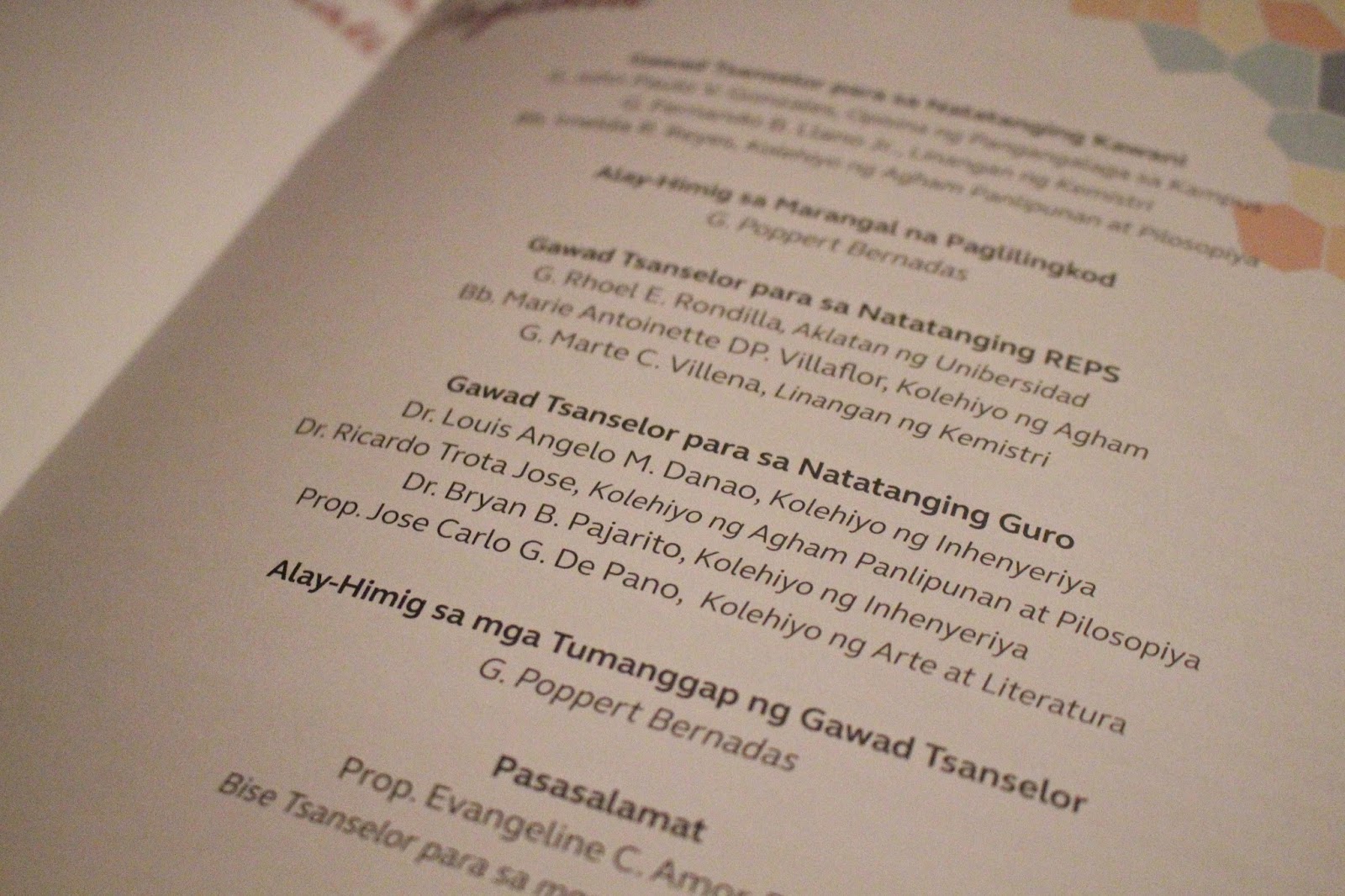
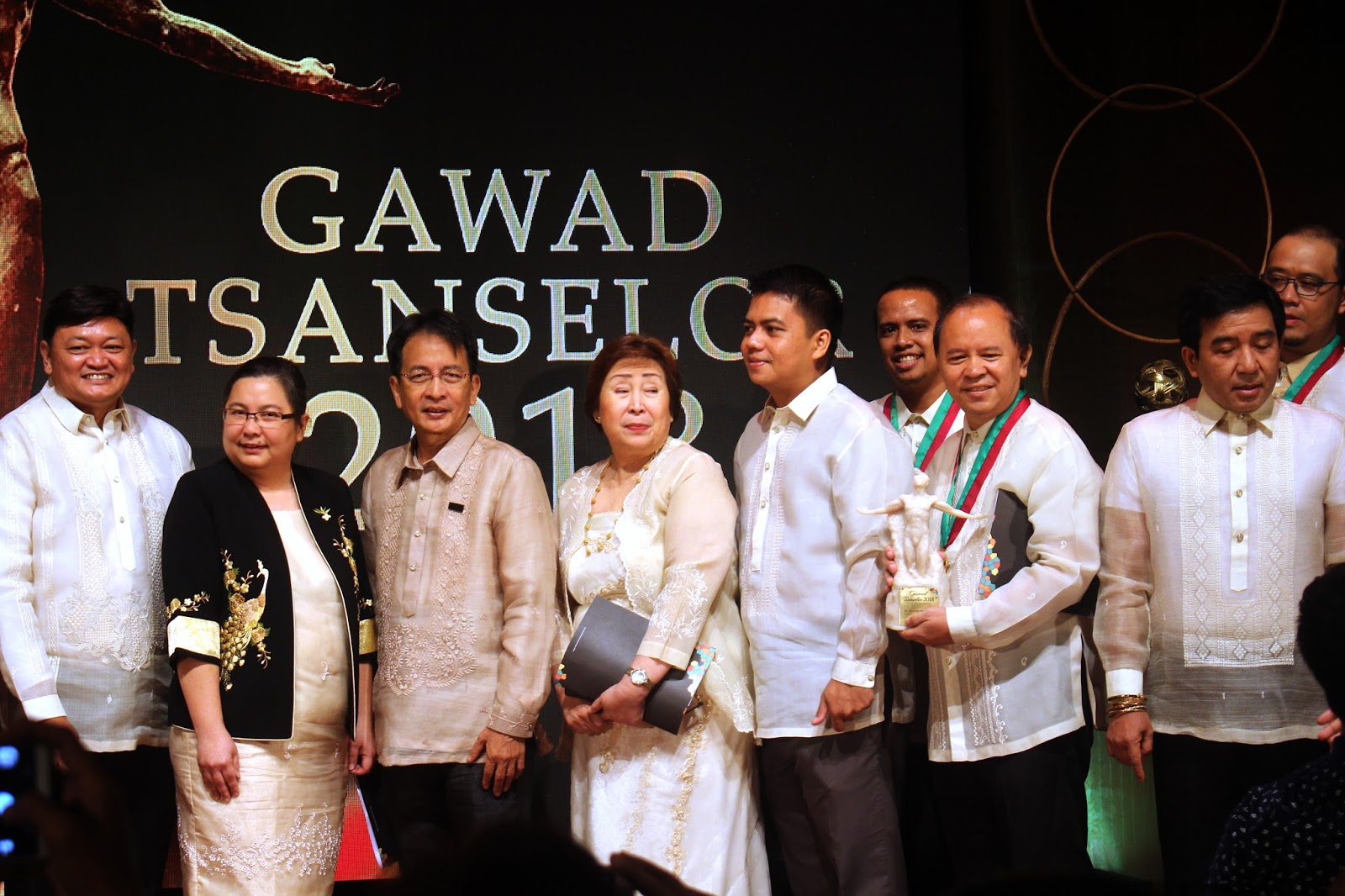
TWSC Director Dr. Ricardo T. Jose Receives his 2018 Gawad Tsanselor para sa Natatanging Guro Award
The Third World Studies Center is extremely proud of its Director Dr. Ricardo T. Jose for being one of the awardees of the 2018 Gawad Tsanselor para sa Natatanging Guro. This is Dr. Jose's third Gawad Tsanselor. In 1999 he received the Gawad Tsanselor for his outstanding work as a researcher and in 2011 and 2018 for him being an outstanding teacher.
Congratulations Sir Rico!





Wednesday, May 02, 2018
Forum 3: Kanino Kinikilig ang Korte Suprema? | Sa Bungad ng Diktadura? Ang 2018 Third World Studies Center Public Forum Series

SA BUNGAD NG DIKTADURA?
Ang 2018 Third World Studies Center Public Forum Series
FORUM 3: KANINO KINIKILIG ANG KORTE SUPREMA?
Ang 2018 Third World Studies Center Public Forum Series
FORUM 3: KANINO KINIKILIG ANG KORTE SUPREMA?
10 Mayo 2018 (Huwebes), 1:00 n.h.-4:00 n.h.
National Engineering Center AVR
University of the Philippines Diliman, Quezon City
University of the Philippines Diliman, Quezon City
Panoorin DITO ang video recordings ng forum na ito.
Programa
12:30 - 1:00 Pagpapatala
01:00 - 1:05 Pagbati, Ricardo T. Jose, PhD, Direktor, TWSC
01:05 - 1:10 Pagpapakilala ng mga Tagapagsalita, Moderator
01:10 - 1:30 Vicente Mendoza, Associate Justice, 1994–2003, Assistant Solicitor General, 1973–1980
01:30 - 1:50 Rene Saguisag, Senator, 1987–1992 (to be confirmed)
01:50 - 2:10 Victoria Avena, Associate Professor, UP College of Law
02:10 - 4:00 Malayang Talakayan
Moderator: Marites Vitug, Editor-at-Large, Rappler
Libre ito at bukas sa publiko (RSVP).
Concept
The Solicitor General is like a persistent suitor of the Supreme Court, an amorous houseguest that seemingly never leaves. Thus, the current SolGen, Jose Calida, has taken to calling himself the “sixteenth justice” of the Supreme Court
Unsatisfied, Calida now demands that if he fails to win his sweetheart's hand, he'll have her thrown out in the streets. That is what can happen if Calida's quo warranto petition to have Chief Justice Maria Lourdes Sereno ejected from the Court succeeds. If that happens, we will trace the origins of a doctrine that can cause the removal of all government officials—even those whom the Constitution states can only be removed via impeachment—to Calida.
Calida’s strategy has deep-seated roots.
Legal experts have stated that our Supreme Court has clarified—if not actually expanded—the extent of the powers of the president under our previous and current constitutions. What is usually not highlighted in such explanations is the role of the office of the Solicitor General. During the dictatorship of Ferdinand Marcos, Lansang v. Garcia was promulgated. That decision reinforced the ability of the Supreme Court to look into the legality of orders by the president, but also stated that the president is in the best position to determine if there is evidence for the reasonable use of his police powers. Such reasoning came from the office of the SolGen, then headed by Felix Antonio—which, in the context of a dictatorship, represented more the interests of Marcos than those of the citizenry.
The sameness in thinking, if not collusion, between the Court and the SolGen does happen. During the Corazon Aquino administration, SolGen Francisco Chavez succeeded in convincing the Court that the president has the power to prevent the immediate repatriation of the remains of Ferdinand Marcos from Hawaii. Recently, Calida has also enjoyed such wins; the Court found meritorious his defense of the legality of President Rodrigo Duterte's order to have Marcos's remains buried in the Libingan ng mga Bayani. In two distinct cases related to a single corpse, both Chavez and Calida resurrected the “political question” doctrine that the Court—and the most prominent Marcos-era SolGen, Estelito Mendoza—was fond of during the Marcos dictatorship.
Such are the moves that the Court and the SolGen make under a ratified constitution; what if there isn't one? We have already experienced being under what some have been clamoring for, a “RevGov” or a revolutionary government. Corazon Aquino established one after EDSA. A month after she became president, using the dictatorial powers she had at the time, Aquino issued a temporary “Freedom Constitution,” which junked several sections of the 1973 Constitution. A few months after a government was formed under the Freedom Constitution, several petitions questioning the legitimacy of the Aquino administration had to be dealt with by the Supreme Court. These petitions were dismissed in a minute resolution, which stated that the legitimacy of Aquino government was not a justiciable matter.
This forum will focus on the possible responses of the Supreme Court if Duterte forms a RevGov. Or, barring that, if Duterte arrogated unto himself unchecked executive powers. If the current Constitution will be disposed of to make Duterte a Supreme Leader, what “fundamental law” will be said to prevail over the country, which the Court will follow—if there will still be a Supreme Court? If, like Corazon Aquino, Duterte issues a Freedom Constitution, can the Supreme Court void it? Will judicial review still exist? If Duterte will not declare a RevGov, can he still become dictator-like—a harsh ruler who is able to make laws or law-like proclamations—that, with a meeting of the minds of the SolGen and the Supreme Court, is not violative of the Constitution?
At the moment, the Supreme Court has entertained a tendentious judicial proceeding against its very own institution in seeming titillation to the sweet nothings that Calida whispers in its ear. The SolGen asks for its heart and the Supreme Court might just give in. Then the next time around, the Solgen will ask for its brain. By that time, the Supreme Court may be quivering in fear instead of titillation. Inured to subservience to the SolGen’s importunings, it might just commit judicial lobotomy.
Sa Bungad ng Diktadura? Ang 2018 Third World Studies Center Public Forum Series:
Forum 1: Matotokhang Ba ang 1987 Constitution?
Forum 2: Puro Bato na Ba ang mga Unipormado?
PHOTOS FROM THE PUBLIC FORUM


Subscribe to:
Posts (Atom)


