Google
 

Wednesday, February 18, 2015

Pope Francis, Charlie Hebdo & Salman Rushie: Thoughts on Religion, War, and Peace (A Public Lecture by Richard Falk)


Pope Francis, Charlie Hebdo & Salman Rushie: Thoughts on Religion, War, and Peace 
(A Public Lecture by Richard Falk)
Tuesday 24 February 2015, 1:00 p.m. to 4:00 p.m.
GT-Toyota Asian Center Auditorium, Asian Center, University of the Philippines Diliman

The Asian Center, in collaboration with Focus on the Global South, the Stop The War Coalition Philippines, The Office of Representative Walden Bello, the UP Department of Political Science, and the UP Third World Studies Center, will be holding a public lecture by Richard Falk, "Pope Francis, Charlie Hebdo, and Salman Rushdie: Thoughts on Religion, War, and Peace," on Tuesday, 24 February 2015, 1:00 p.m. to 4:00 p.m., at the GT-Toyota Asian Center Auditorium, Asian Center, University of the Philippines Diliman. The lecture is free and open to the public.

Richard Anderson Falk is Albert G. Milbank Professor Emeritus of International Law at Princeton University and Visiting Distinguished Professor in Global and International Studies at the University of California, Santa Barbara. In 2001, he served on a three-person Human Rights Inquiry Commission for the Palestine Territories that was appointed by the United Nations, and previously, on the Independent International Commission on Kosovo. He is the author or coauthor of numerous books, including The Great Terror War (2003), Religion and Humane Global Governance; Human Rights Horizons; On Humane Governance: Toward a New Global Politics; Explorations at the Edge of Time; Revolutionaries and Functionaries; The Promise of World Order; Indefensible Weapons; Human Rights and State Sovereignty; A Study of Future Worlds; and This Endangered Planet. He is coeditor of Crimes of War.

Professor Falk serves as Chair of the Nuclear Age Peace Foundation's Board of Directors and as honourary vice president of the American Society of International Law. He also acted as counsel to Ethiopia and Liberia in the Southwest Africa Case before the International Court of Justice. He received his BS from the Wharton School, University of Pennsylvania; his LLB from Yale Law School; and JSD from Harvard University. In March 2008, the United Nations Human Rights Council appointed Falk to a six-year term as UN Special Rapporteur on Palestinian Human Rights. He initiated a blog, "Global Justice in the 21st Century" in celebration of his 80th birthday, richardfalk.wordpress.com.

Interested participants may send their inquiries or confirm their attendance via asiancenter@up.edu.ph. Seating is on a first-come, first-served basis. 

Friday, January 30, 2015

REGISTRATION NOW OPEN: Contested Access to Land in the Philippines and Indonesia, an international conference


Contested Access to Land in the Philippines and Indonesia: 
How Can the Rural Poor (Re)gain Control?
An International Conference
16-17 February 2015
GT Toyota Asian Cultural Center, Asian Center,
University of the Philippines-Diliman, Quezon City


The Amsterdam Institute for Social Science Research, the Netherlands Organisation for Scientific Research, the Asian Center, and the Third World Studies Center, will be holding an international conference, Contested Access to Land in the Philippines and Indonesia: How Can the Poor (Re)gain Control? from 16 to 17 February 2015 at the Asian Center and the University Hotel, both in the University of the Philippines Diliman.

This two-day conference reflects critically on recent trends in land-related issues, including a “global land grab,” the leasing of land to more capitalistic entrepreneurs, and other types of investments that alienate poor land users from their land. Contested by various stakeholders in varying ways and degrees, these land-deals render the rural poor vulnerable, voiceless, and disempowered, and have become an urgent concern of researchers and nongovernmental organization (NGO) activists.


This conference is FREE and OPEN TO THE PUBLIC, but pre-registration is REQUIRED. Please visit the conference's official website here to register.

DEADLINE FOR REGISTRATION is on 10 February 2015.

For more information about the conference, contact Joel Ariate, the conference secretariat, via uptwsc@gmail.com.

Tuesday, January 20, 2015

Filipinos in Northern Japan after the March 11 Earthquake: A Public Lecture by Dr. Takefumi Terada


LECTURER: 
Takefumi Terada, PhD
Professor and Dean
Faculty of Global Studies
Sophia University

26 January 2015 (Monday)
10:00 a.m. - 12:00 noon
 Third World Studies Center
Lower Ground Floor
Palma Hall
College of Social Sciences and Philosophy
University of the Philippines-Diliman

In 2011, a few days after the disasters of March 11, a considerable number of Filipinos were evacuated to Tokyo from the Sendai and Fukushima areas along with their children. Approximately 150 were received at several evacuation centers located at churches in Tokyo. The earthquake, tsunami, and nuclear power accident at Fukushima undeniably affected the lives of these people, most of whom are women married to Japanese.

A significant transformation that is currently visible among them, is the fact that many Filipino women now appear at various Catholic churches in the Tohoku area to attend mass. In certain places, reciting the rosary in groups, or block rosary, has been introduced.

Prior to March 11, no Filipino priest was employed in the Catholic Sendai Diocese, (which comprises the prefectures of Aomori, Iwate, Miyagi, and Fukushima). Realizing the importance of organizing a regular Tagalog or English mass for the Filipinos, the Catholic Church has decided to assign two priests, namely a Filipino and an Indonesian who is fluent in Tagalog, to form work at Ofunato, and to serve other Filipino communities as well as other foreigners in the devastated areas.

The Filipinos for a variety of reasons had earlier faced several obstacles in coming to church and attending mass. However, the churches in their respective vicinities have been transformed into centers for gatherings and networking hubs. The sense of being a Filipino in Japan and a Catholic is certainly awakened through the months following the March 11.

The Filipino community of Shinjo Church in Yamagawa will also be discussed. 


ABOUT THE LECTURER

Takefumi Terada, PhD is currently professor and dean of the Faculty of Global Studies, Sophia University in Tokyo, Japan. His major areas of research include folk Catholicism and popular religiosity in the Philippines, and Christian churches in the Philippines during the Japanese occupation period. Formation of Filipino communities within the Catholic Church in Japan is also a topic of his field research. Since March 2011, he has been working on Filipinos and Filipino communities in northern part of Japan affected by the Great East Japan Earthquake. Dr. Terada obtained his PhD from the Philippine Studies Program of the University of the Philippines-Diliman, and served as president of the Japan Society for Southeast Asian Studies (2011-2012).

Tuesday, January 06, 2015

The 2014 UP TWSC Public Lecture Series on Natural Disasters Lecture 5--Imperiled Heritage, A Heritage of Peril: History and Legacy of Natural Disasters


The 2014 UP TWSC Public Lecture Series on Natural Disasters

LECTURE 5

Imperiled Heritage, A Heritage of Peril
History and Legacy of Natural Disasters
27 January 2015 (Tuesday), 9:30 – 11:30 a.m.
Pulungang Claro M. Recto, Bulwagang Rizal (Faculty Center)
University of the Philippines, Diliman, Quezon City


PROGRAM
9:30 – 9:40 
Opening Remarks 
Elena R. Mirano, PhD
Dean, College of Arts and Letters
University of the Philippines Diliman

9:40 – 9:45 
Introduction of the Role Players

9:45 – 10:25 
Lecture
Atty. Rose Beatrix Cruz-Angeles
Legal Consultant
National Commission for Culture and the Arts

10:25 – 10:55
Reactions
Carlo A. Arcilla, PhD
Professor, National Institute of Geological Sciences
College of Science
University of the Philippines Diliman

Patrick D. Flores, PhD

Professor, Department of Art Studies
College of Arts and Letters and 
Curator, Vargas Museum
University of the Philippines Diliman

10:55 – 11:20 
Open Forum

11:20 – 11:30 
Closing Remarks
Ricardo T. Jose, PhD
Director, Third World Studies Center
College of Social Sciences and Philosophy
University of the Philippines Diliman

Moderator
Prof. Jely A. Galang
Deputy Director, Third World Studies Center and
Assistant Professor, Department of History
College of Social Sciences and Philosophy
University of the Philippines Diliman


ABOUT THE LECTURE
Catastrophic calamities devastate not only the tangible present but also the reminders of the fading past. When the heritage churches of Bohol, among the oldest in Asia, crumbled in the 2013 earthquake, many lamented the “national cultural treasures” having been reduced into rubble. The churches, according to the National Committee on Culture and the Arts (NCCA), “are artifacts of memory”—they “form ‘part of the soul of the community.’” Similarly, when Yolanda’s wrath felled the statue of Carlos P. Romulo, one of the seven bronze figures in the MacArthur Landing Memorial, in commemoration of a key event in America’s effort during the Second World War to retake the Philippines from Japanese occupation, the Metropolitan Manila Development Authority (MMDA) immediately set to work its restoration. MMDA chair Francis Tolentino averred that “By restoring this memorial, we hope to inspire the Leyte people to rise again. Like General MacArthur declared, we shall return." In the twin disasters of 2013, earthquakes tampered with topography and disrupted the surefooted rhythm of local lives as these break belfries of faith and bury to the ground a culture’s material achievements. Floods and storm surges drowned bodies and reshaped the margins of habitable earth as these submerged histories that anchor identities, inundated and broke the tenuous link between generations and its heritage. Calamities are fires of societal transformations that force the living to sift through and find value in the ashes of what’s left, divine the past from the soot marks, and devise new spaces of being and belonging from the razed ground. Spaces that both honor society’s loss and pain are the very same spaces that herald society’s unyielding quest for permanence and remembrance. Heritage needs not only be conserved but reclaimed. Histories need not only be taught but rewritten and retold. Songs and practices that perform the past in the present must be drawn again from memories of minds muddled by the trauma of disasters. Despite the country’s limited resources, heritage compelled the need to stand up to unprecedented risks and rebuild the tangible and the intangible, epitomized by “Task Force Heritage.” But between the hunger pangs of the survivors and the elite’s penchant to preserve their very own legacy, is there a formulary of prioritization to address in humane and timely manner the need of the body and the need of the soul? Is there a point and value in giving up and just letting nature take its course on the material legacies of the past?


KEY QUESTIONS 
1. If heritage is only one of the means of accessing the past, why privilege it over other ways, even in times of natural disasters? Or does seeing it the subject of sudden and irreversible devastation creates a sense of urgency that may not be totally justified? What are historical examples of such in the country?

2. Given the increasing vulnerability of the country from unprecedented risks of natural disasters, has the government consistently looked out for the preservation of its “natural cultural treasures”? 

3. Should it always be government institutions that must bear the onus of securing heritage sites? Who are the other stakeholders at work, if any?

4. Is there a point and value in giving up and just letting nature take its course on the material legacies of the past?


See link for the concept paper of the public lecture series.


Monday, December 01, 2014

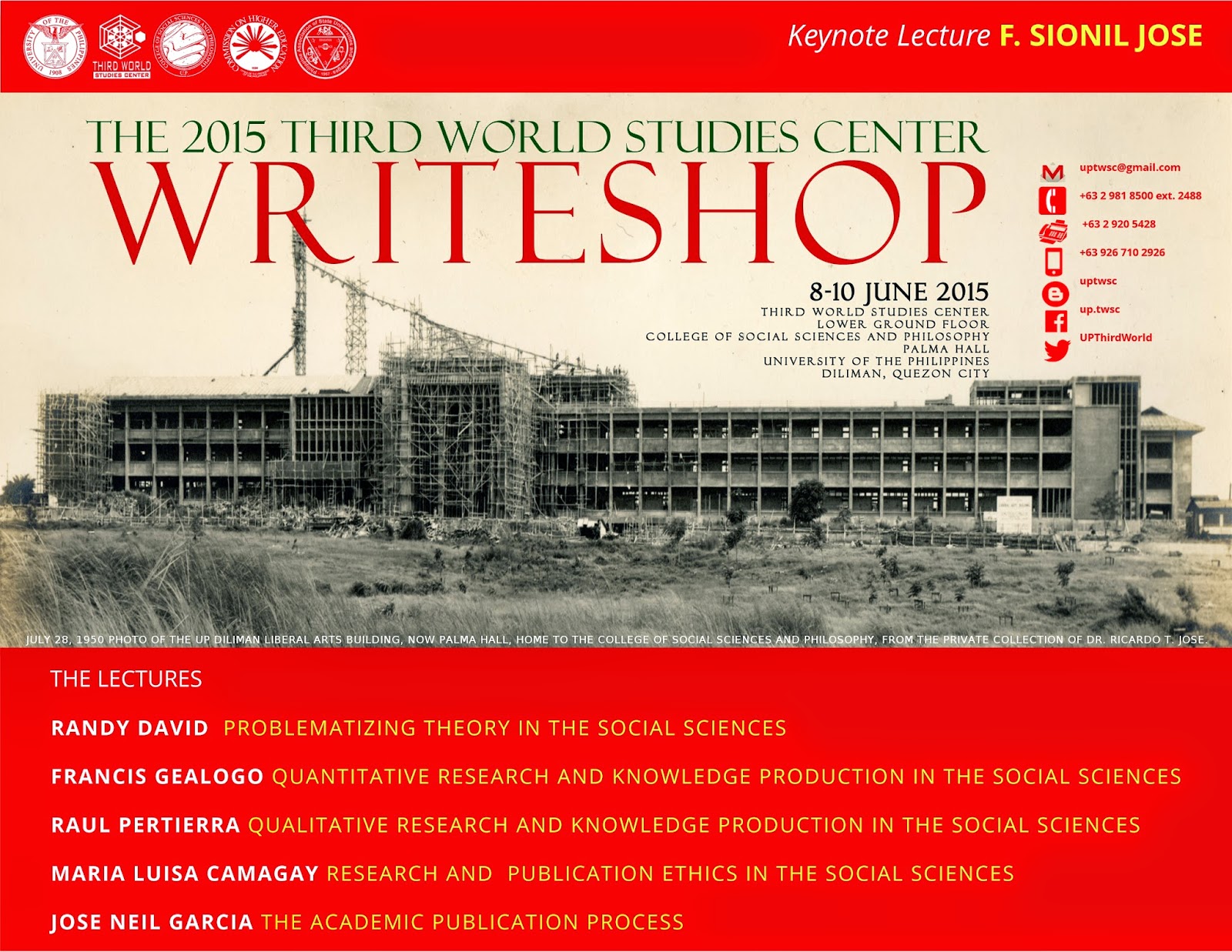
Call for Applications: The 2015 TWSC Writeshop


CALL FOR APPLICATIONS

The 2015 TWSC Writeshop
Third World Studies Center, Lower Ground Floor,
College of Social Sciences and Philosophy,
Palma Hall, University of the Philippines, Diliman, Quezon City
8-10 June 2015


About the writeshop

The Third World Studies Center (TWSC) launches the 2015 TWSC Writeshop in continuing its commitment to build the capacity of early career researchers, junior faculty members, and graduate students in the social sciences. Envisioning itself as a premiere social science research center in the College of Social Sciences and Philosophy, University of the Philippines-Diliman, the TWSC continues to develop critical, alternative paradigms to promote progressive scholarship by undertaking pioneering research and publishing original, empirically-grounded, and innovative studies. The 2015 TWSC Writeshop serves as a dais linking academic research and publication, where select participants are not only given the opportunity to interact with experts from the academe and the publishing industry, but also to produce a publishable manuscript for the TWSC’s internationally refereed and CHED-accredited (A-2, Very Good - Excellent)  journal Kasarinlan: Philippine Journal of Third World Studies.

In 2010, the TWSC conducted its pilot research workshop entitled “Writing for Social Sciences Research” that presented the rudimentary process of academic research and writing in the social sciences for UP Diliman social science students. In 2012, it held its second research workshop, “Multidisciplinary Perspectives and Methodologies in the Social Sciences” that centered on multidisciplinarity and theoretical and methodological training within and outside the social sciences. In 2014, the TWSC launched “The 2014 UP TWSC Writeshop” with the belief that if one is to commit to the changing zeitgeist/sociocultural agenda of research, s/he has to effectively contribute to the body of knowledge in her/his interest, to establish networks with scholars with similar research interests, and to obtain critique for the continuous improvement of one’s research output. The 2015 TWSC Writeshop sustains this academic tradition.

The 2015 TWSC Writeshop will feature academic lectures; small group discussions with journal editors; and a plenary presentation as culminating activity. The lectures encompass: 1) problematizing theory in the social sciences; 2) the contribution of quantitative research to knowledge production in the social sciences; 3) the contribution of qualitative research to knowledge production in the social sciences; 4) research and publication ethics in the social sciences; and 5) the academic publication process. In seeing through the TWSC Writeshop’s goal in equipping successful applicants, who would then be called Writeshop Fellows, the Writeshop extends to the publication process and concludes with the publication of the finished manuscripts in a special issue in Kasarinlan.

Who may apply

There will only be ten (10) successful applicants who will be called Writeshop Fellows. Applicants can be social science graduate students, early career researchers, and junior faculty members from any Philippine higher education institution. Applicants who have not yet participated in previous TWSC writeshops will be prioritized.

What to submit

Applicants must be able to submit the following to uptwsc@gmail.com on or before 20 March 2015:

1.    An unpublished article, authored solely by the applicant, with a minimum of 4,000 words, an abstract and a list of references, that can be developed into a full-length article for publication in the Center’s internationally refereed and CHED-accredited (A-2, Very Good - Excellent) journal Kasarinlan: Philippine Journal of Third World Studies. Submission must conform to the publication format of the journal (http://journals.upd.edu.ph/index.php/kasarinlan/information/authors). The draft article must demonstrate theoretical rigor and be empirically sound or based on actual research. Submissions will be plagiarism-checked. The submission must conform to the template downloadable here:  http://goo.gl/F7GgY7.
2.    Soft copy of latest curriculum vitae with references.

What to expect after submission of requirements

1.    All submissions will undergo plagiarism check by the Kasarinlan editorial staff. Submissions without plagiarized contents will undergo preliminary editorial evaluation by the Kasarinlan editorial staff. Ten submissions will be selected, with graduate students, early career researchers, and junior faculty members to be given priority.
2.    The ten applicants whose submissions were selected will be notified by email, including  the terms of reference (TOR) for the Writeshop. They must convey their full understanding, agreement, and acceptance of the TOR by sending the signed TOR to uptwsc@gmail.com.
3.    There is no registration fee. Successful applicants based outside of Metro Manila may apply for subsidies, in the forms of per diem and reimbursed travel expenses subject to government accounting rules. Those who would like to avail of the above subsidies must send a signed letter addressed to the Director, Dr. Ricardo T.  Jose to uptwsc@gmail.com, with clear justification on why they are requesting for such.


What to expect during the writeshop

Day 1   

    Keynote lecture by F. Sionil Jose, National Artist
  
    Introduction of Writeshop Fellows
    
     Module 1 Ano’ng problema mo?: Problematizing theory in the social sciences by Randy David, Professor Emeritus, Department of Sociology, University of the Philippines Diliman

    Module 2 Ano’ng kuwento ng kuwenta mo?: Quantitative research and knowledge production in the social sciences by Francis Gealogo, Associate Professor, Department of History, Ateneo de Manila University

    Module 3 Ano’ng kuwenta ng kuwento mo?: Qualitative research and knowledge production in the social sciences by Raul Pertierra, Professorial Lecturer, Department of Sociology and Anthropology, Ateneo de Manila University

Day 2   

    Module 4 Ano’ng paki mo?: Research and publication ethics in the social sciences by Maria Luisa Camagay, Professor, Department of History, University of the Philippines Diliman

    Module 5 So, ano na?: The academic publication process by Jose Neil Garcia, Director, University of the Philippines Press

Day 3    
  • Non-blind peer review in the form of small-group discussions with assigned journal editors
  • Culminating activity: Plenary presentation of participants
  • Awarding of certificates

About the lectures

1.    Ano’ng problema mo?: Problematizing theory in the social sciences
The lecture broadly seeks to rethink the problematization process in social science research by renewing appreciation for and rethinking the import of theorizing in the social sciences. Zooming in on producing a publishable output with rigor in theory use, the lecture is deliberate in also giving critical and constructive inputs on the Writeshop Fellows’ theoretical and analytical concepts, in the form of a collegial academic exercise.

2.    Ano’ng kuwento ng kuwenta mo?: Quantitative research and knowledge production in the social sciences
The lecture broadly seeks to give fresh perspectives on quantitative studies and how they expand—as opposed to limit to numbers and figures—social science analysis. It also seeks to give a balanced perspective on the strengths and weaknesses of quantitative approaches to inculcate meaningful appreciation and applied knowledge in producing a quantitative research publication.  The lecture also entails giving critical and constructive inputs on the Writeshop Fellows’ methodological concepts, procedures, and analyses in the form of a collegial academic exercise.

3.    Ano’ng kuwenta ng kuwento mo?: Qualitative research and knowledge production in the social sciences
The lecture broadly seeks to give fresh perspectives on qualitative studies and how they meld subjectivities with rigor in social science analysis. It also seeks to give a balanced perspective on the strengths and weaknesses of qualitative approaches to inculcate meaningful appreciation and applied knowledge in producing a qualitative research publication. The lecture also entails giving critical and constructive inputs on the Writeshop Fellows’ methodological concepts, procedures, and analyses in the form of a collegial academic exercise.

4.    Ano’ng paki mo?: Research and publication ethics in the social sciences
The lecture seeks to question “ethics as a given” in social science research and probe established and contemporary ethical practices on conceptualizing, carrying out, and disseminating research in the social sciences. It also seeks to orient the participants to the publication process and its imperative ethical practice. The lecture also entails giving critical and constructive inputs on the Writeshop Fellows’ ethical research conduct and writing practice in the form of a collegial academic exercise.

5.    So, ano na?: The academic publication process
The lecture seeks to give participants a grounded appreciation for academic publishing in the social sciences. It seeks to serve as guide on what they can expect in the publication process. The lecture will be followed by an open forum where the Writeshop Fellows can further engage the speaker on a discussion about academic publication.

Upon completion of the Writeshop, the Fellows are expected to: 1) have an increased awareness of academic publishing; 2) have an increased awareness of the publication process; and 3) continue their engagement with the TWSC for possible publication of their manuscript in Kasarinlan.

What to expect after the writeshop

June 24, 2015
Deadline of first revision (two-week timeframe)

July 8, 2015
Notify authors of editorial evaluation of revisions: Further revisions or copyediting

July 22, 2015
Deadline of final revision (two-week timeframe)

August 5, 2015
Notify authors whose articles will be published in Kasarinlan

For inquiries:

Elinor May K. Cruz
University Research Associate
Third World Studies Center
University of the Philippines-Diliman
Lower Ground Floor, Palma Hall
University of the Philippines
1101 Diliman, Quezon City

E-mail: uptwsc@gmail.com
Telephone: +63 2 981 8500 ext. 2488
Telefax: +63 2 920 5428
Mobile: +63926 710 2926

Please click here for CHED endorsement.

Please click here for Philippine Association of State Universities and Colleges advisory.